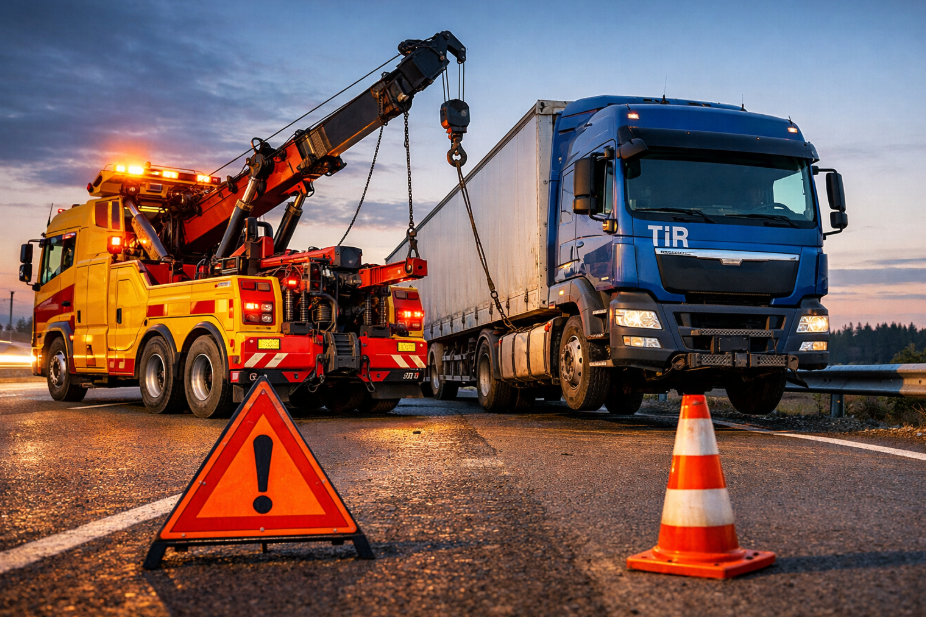
Breakdowns involving heavy vehicles rarely happen at a convenient time. A loaded truck can stop on a motorway, near a border crossing, on a local road, or in the middle of a demanding delivery schedule. In situations like these, fast and professional support matters more than anything else. Reliable holowanie TIR services help reduce downtime, protect cargo, improve road safety, and get transport operations back on track with minimal disruption. For fleet owners, drivers, and logistics managers, knowing how professional towing works can make a major difference when every minute counts.
Why Heavy Vehicle Towing Requires Specialized Support
Towing a passenger car and recovering a heavy commercial vehicle are two completely different tasks. A TIR truck has a much larger mass, more complex systems, and often carries valuable or sensitive cargo. That means a standard tow truck is not enough. Heavy vehicle assistance requires advanced recovery equipment, trained operators, route planning, and a strong understanding of safety procedures.
Professional providers handle more than just moving a disabled truck from one point to another. They assess road conditions, traffic flow, axle load, trailer position, brake issues, and the overall technical state of the vehicle before taking action. This level of preparation reduces risk and helps avoid further mechanical damage.
In the transport sector, delays can quickly lead to financial losses. Missed delivery windows, contract penalties, spoiled goods, and blocked routes all create pressure. That is why choosing a dependable towing partner is not only a practical decision but also a strategic one.
Common Situations That Call for TIR Towing
Heavy vehicle towing services are needed in a wide range of scenarios. Some incidents are sudden, while others develop over time due to wear, poor weather, or road conditions.
The most common situations include:
- engine failure during transit
- gearbox or clutch problems
- air brake malfunctions
- tire blowouts affecting control
- electrical system breakdowns
- collisions involving trucks or trailers
- vehicles stuck in mud, snow, or roadside ditches
- overturned or jackknifed combinations
- transport units that cannot continue safely after inspection
In each of these cases, speed is important, but precision is even more important. A rushed or poorly executed recovery can damage the truck, the trailer, the load, or nearby infrastructure.
What Sets Professional Towing Apart
A professional heavy recovery company brings much more than a strong recovery vehicle. It offers a full-service response designed specifically for commercial transport needs.
This usually includes:
- access to heavy-duty tow trucks and rotators
- trained operators experienced with articulated vehicles
- assistance for tractors, trailers, buses, and construction vehicles
- safe lifting and winching procedures
- on-site diagnostics when possible
- support available day and night
- coordination with police, road services, and insurers when needed
These capabilities matter because heavy vehicle incidents can become complicated very quickly. A truck blocking part of the roadway requires a different response than a vehicle parked safely on the shoulder. A loaded semi-trailer may also require additional stabilization before it can be moved.
Experienced towing teams know how to work efficiently under pressure without compromising safety. That balance is one of the clearest signs of a high-quality service provider.
The Role of Fast Response in Transport Continuity
Every hour a truck remains immobilized can affect an entire logistics chain. Dispatchers must reorganize schedules, clients wait for deliveries, and drivers lose valuable working time. In industries such as retail distribution, construction supply, refrigerated transport, and international freight, even a short delay can trigger wider operational problems.
Fast response does not simply mean arriving quickly. It also means arriving prepared. The best towing teams gather information before they reach the scene. They ask about the vehicle type, cargo weight, trailer condition, exact location, and visible mechanical issues. This helps them dispatch the right equipment from the start.
A professional response process often follows these steps:
- Incident details are collected from the driver or transport manager.
- The nearest suitable heavy recovery unit is assigned.
- Operators assess access conditions and traffic risks.
- Recovery or towing begins using the correct method.
- The vehicle is moved to a workshop, depot, or safe parking area.
This organized workflow reduces confusion and helps everyone involved make better decisions under stress.
Safety Comes First at Every Stage
Heavy vehicle recovery is not only about restoring movement. It is also about protecting people and the surrounding environment. A broken-down truck can become a hazard for other drivers, especially on busy roads, in poor visibility, or on curves and narrow lanes.
Professional operators use safety protocols that cover:
- scene protection and traffic management
- stabilization of damaged vehicles
- prevention of fuel or fluid leakage
- controlled lifting and towing angles
- cargo security during recovery
- compliance with road and transport regulations
These precautions are essential because mistakes in heavy towing can have serious consequences. A poorly attached towing setup or incorrect load distribution can worsen the situation instead of solving it. Reputable operators understand both the technical and legal sides of the job, which gives clients added confidence during a difficult moment.
See also: Smart Online Marketing 636627266 for Businesses
Why Regional Knowledge Matters
A towing company with good regional coverage offers a strong advantage. Local familiarity helps operators reach the site faster and choose better routes for recovery. It also improves coordination when a vehicle needs to be taken to a nearby workshop, secure yard, or service point.
This is especially useful in industrial regions, urban transport hubs, and areas with intense truck traffic. In the middle of a demanding haul, access to dependable Pomoc Drogowa TIR can help drivers and transport companies resolve unexpected problems without unnecessary delays. When support teams know the roads, restrictions, access points, and common traffic bottlenecks, the entire process becomes smoother and safer.
Regional expertise also matters for cross-border and long-distance carriers. Drivers moving through unfamiliar territory need assistance they can trust immediately. A professional provider with strong local presence can step in quickly and communicate clearly at every stage.
Equipment Used in Heavy Vehicle Recovery
Heavy towing is only as effective as the equipment behind it. Modern recovery companies invest in specialized machinery designed for the weight and complexity of commercial transport vehicles.
Depending on the incident, equipment may include:
- heavy-duty tow trucks with high-capacity booms
- hydraulic winches for controlled extraction
- underlift systems for tractor units
- rotators for overturned vehicles
- air cushion recovery systems in selected cases
- support vehicles for road safety and technical assistance
The right equipment allows the team to adapt to different situations. A tractor-trailer stuck on soft ground may need a different approach than a rigid truck with front axle damage. A bus on a roadside embankment presents another unique challenge. The ability to match tools to the situation is what keeps the operation efficient and controlled.
How Professional Assistance Protects Your Vehicle and Cargo
Transport companies often focus first on the towing cost, but the real value lies in damage prevention. Improper handling can cause suspension strain, body damage, trailer instability, cargo shifting, and extra repair expenses. A skilled towing team understands how to reduce these risks from the first contact point to the final drop-off location.
This is particularly important for:
- refrigerated trailers carrying temperature-sensitive goods
- tankers and specialized industrial vehicles
- trucks with partial mechanical failure
- overloaded or poorly balanced transport units
- vehicles involved in collisions
Professional handling protects not just the truck, but the business behind it. Lower secondary damage means quicker repairs, fewer disputes, and a better chance of maintaining customer commitments.
What Fleet Managers Should Look For in a Towing Partner
Not every provider is equally prepared for heavy commercial vehicle support. Fleet managers should evaluate towing partners before an emergency happens. Waiting until a breakdown occurs usually leads to rushed decisions.
A strong provider should offer:
- 24/7 availability
- proven experience with heavy vehicles
- clear communication during incidents
- rapid dispatch capability
- modern recovery equipment
- trained and insured personnel
- transparent pricing and documentation
It is also worth checking whether the company can assist with more than towing alone. Some providers offer roadside diagnostics, minor technical support, accident recovery, secure storage, and coordination with repair workshops. These added services can simplify the situation for transport businesses that need a complete solution.
The Importance of Communication During a Breakdown
When a heavy vehicle stops unexpectedly, clear communication becomes essential. Drivers need to know help is coming. Dispatchers need updates. Clients may need revised delivery information. Workshops need to prepare for the incoming vehicle.
Professional towing companies stand out by maintaining communication throughout the process. They provide realistic arrival times, explain the recovery plan, and keep the transport company informed about progress. This reduces uncertainty and helps businesses respond more calmly and effectively.
Good communication also builds trust. In a high-pressure situation, a confident and organized service team can make a major difference in how smoothly the recovery unfolds.
Keeping Heavy Transport Moving with Confidence
Heavy vehicle incidents are never welcome, but they do not have to turn into long and costly disasters. With the right towing support, a breakdown becomes a manageable challenge instead of a major operational crisis. Professional TIR towing services combine technical skill, specialized equipment, rapid response, and strong safety standards to help drivers and transport companies return to normal operations as quickly as possible.
For businesses that rely on trucks every day, dependable support is part of responsible transport planning. Whether the issue involves mechanical failure, accident recovery, or roadside assistance, choosing experienced specialists helps protect vehicles, cargo, schedules, and reputation. In a sector where reliability matters every day, the value of professional help becomes clear the moment the unexpected happens.