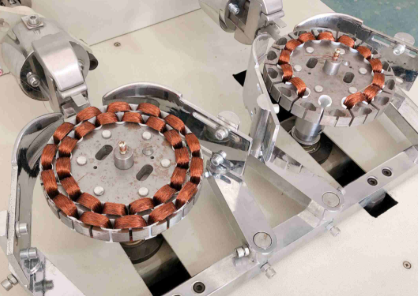
The production of electric motors requires accuracy, consistency, and efficient manufacturing processes. Among the most important stages of motor manufacturing is stator winding, where insulated copper wire is precisely placed into the stator core to create the required electromagnetic field. Modern automation has made this process faster and more reliable. A motor stator winding machine can support specialized winding applications where traditional core-based methods are not suitable, while an integrated stator production line can connect winding, assembly, testing, and inspection operations into one streamlined workflow. Understanding the key features and benefits of modern stator winding equipment can help manufacturers improve productivity and maintain consistent product quality.
What Is a Stator Winding Machine?
A stator winding machine is specialized industrial equipment designed to wind copper or aluminum wire around the slots or structures of a motor stator. The stator is the stationary part of an electric motor and works together with the rotor to generate rotational movement.
Depending on the motor design, different winding techniques may be required. Modern machines can be configured for various stator sizes, winding patterns, wire diameters, and production requirements. Automated systems use programmed controls to manage winding speed, wire tension, positioning, and the number of turns.
By automating these processes, manufacturers can achieve greater consistency compared with manual winding methods.
Key Feature: Precision Winding Control
Precision is one of the most important characteristics of modern stator winding equipment. The machine must place wire accurately to create uniform coils and maintain the required winding pattern.
Advanced winding systems use controlled motors, sensors, and programmable movement mechanisms to guide the wire. Operators can configure parameters according to the specifications of the stator being produced.
Accurate wire placement helps minimize common problems such as overlapping wires, uneven layers, excessive gaps, and inconsistent coil dimensions.
Programmable Operating Parameters
Modern stator winding machines often provide programmable controls that allow manufacturers to configure multiple production settings. These can include winding speed, wire tension, number of turns, movement distance, acceleration, and other parameters.
Once a suitable program has been created, it can be stored and reused for future production. This makes the manufacturing process more repeatable and reduces the need for manual adjustments.
Programmable controls are particularly useful for manufacturers producing multiple motor models with different winding requirements.
Automatic Wire Tension Management
Wire tension directly affects winding quality. If tension is too low, the wire may become loose or poorly positioned. If tension is too high, the wire can stretch, break, or suffer insulation damage.
Modern equipment may use tension-control systems to maintain stable wire pressure during the winding cycle. Consistent tension contributes to better coil formation and helps reduce defects.
Reliable tension management becomes even more important when manufacturers work with fine wires or high-speed production processes.
High-Speed Production Capability
Industrial manufacturers often need to produce thousands of components while maintaining consistent quality. Automated stator winding machines can perform repetitive operations faster than manual production.
High-speed winding reduces cycle times and can increase overall manufacturing capacity. However, speed must be carefully balanced with precision. Advanced equipment is designed to maintain programmed winding parameters while operating efficiently.
Faster production can help manufacturers meet customer orders and improve the utilization of their manufacturing facilities.
Improved Product Consistency
Consistency is essential in electric motor production because every stator must meet defined electrical and mechanical requirements. Differences in winding patterns can affect resistance, magnetic performance, and overall motor operation.
Automated winding equipment follows programmed processes, helping produce similar winding results from one cycle to another. This repeatability can simplify quality inspection and reduce variations between production batches.
Consistent production also makes it easier for manufacturers to identify process problems and implement corrective measures.
Reduced Labor Requirements
Manual winding can require considerable time and repetitive effort. Automation reduces the need for workers to perform every winding movement manually.
Instead, operators can focus on machine setup, production monitoring, inspection, maintenance, and quality control. This allows skilled employees to contribute to higher-value manufacturing activities.
Automation can also help reduce errors caused by fatigue or variations in manual working techniques.
Lower Material Waste
Copper wire is an important and often costly material in motor manufacturing. Poor winding practices can lead to damaged wire, incorrect coils, and rejected stators.
Precision equipment helps control wire placement and winding parameters, reducing unnecessary material consumption. Accurate winding can also reduce the amount of rework required.
Lower material waste can contribute to better cost control while making production more resource-efficient.
Integration With a Stator Production System
A modern stator production line can combine multiple manufacturing stages into a connected workflow. Depending on the factory’s requirements, it may include core assembly, winding, wire forming, insulation processes, terminal connections, testing, and inspection.
Integrating these stages can reduce unnecessary handling and improve material flow. Automated transfer systems can move stators between workstations, while sensors and controllers can monitor production activities.
This type of connected manufacturing environment can provide better control over production schedules and overall equipment utilization.
Industrial Applications
Stator winding machines are used across many industries that manufacture electric motors and electromagnetic components. Common applications include industrial motors, household appliances, automotive components, pumps, fans, compressors, power tools, and automation equipment.
The specific machine configuration depends on the stator design and production requirements. High-volume manufacturers may prioritize automation and cycle speed, while specialized manufacturers may require flexible equipment capable of handling multiple stator models.
Application in Electric Vehicle Manufacturing
Electric mobility has increased the demand for advanced motor manufacturing technologies. Electric vehicles, hybrid systems, electric scooters, and other transportation technologies rely on efficient electric motors.
Stator winding equipment can support the production of motor components used in these applications. Precision winding is particularly important because motor performance, efficiency, and reliability depend on accurately manufactured electrical components.
Automated production also helps manufacturers maintain repeatability when producing large numbers of motor assemblies.
See Also: Benefits and Risks of Social Media Technology
Application in Industrial Automation
Industrial automation systems use motors in conveyors, robotic equipment, machine tools, pumps, and other machinery. Reliable motor production is therefore important for many manufacturing sectors.
Stator winding machines allow motor manufacturers to produce consistent components at commercial volumes. Their programmable nature also makes them suitable for different motor designs and production requirements.
Quality Testing and Inspection
Winding is only one stage of motor production. After winding, manufacturers often perform electrical and flyer machine tests to verify that the component meets required specifications.Modern production environments can connect winding machines with automated testing systems. Testing may evaluate characteristics such as resistance, insulation, continuity, and other application-specific parameters.Combining automated winding with testing can help identify defective components before final motor assembly.
Maintenance and Long-Term Reliability
Regular maintenance is essential for keeping winding equipment operating efficiently. Wire guides, tension systems, motors, sensors, mechanical components, and electrical controls should be inspected according to the manufacturer’s recommendations.
Preventive maintenance can help reduce unexpected downtime and maintain consistent production quality. Operators should also receive appropriate training so they can identify potential problems and perform basic machine checks.
Conclusion
Modern stator winding technology provides manufacturers with greater control over precision, speed, consistency, and production efficiency. A coreless winding machine can serve specialized applications, while an integrated stator production line can connect winding with assembly, testing, and inspection to create a more efficient manufacturing workflow.
As demand for electric motors continues to grow across automotive, industrial, appliance, automation, and other sectors, manufacturers are increasingly focused on reliable and scalable production technologies. By choosing suitable winding equipment, using programmable controls, maintaining accurate wire tension, and integrating quality testing, manufacturers can improve productivity while maintaining consistent stator quality.