The Evolution of Assessment in British Universities
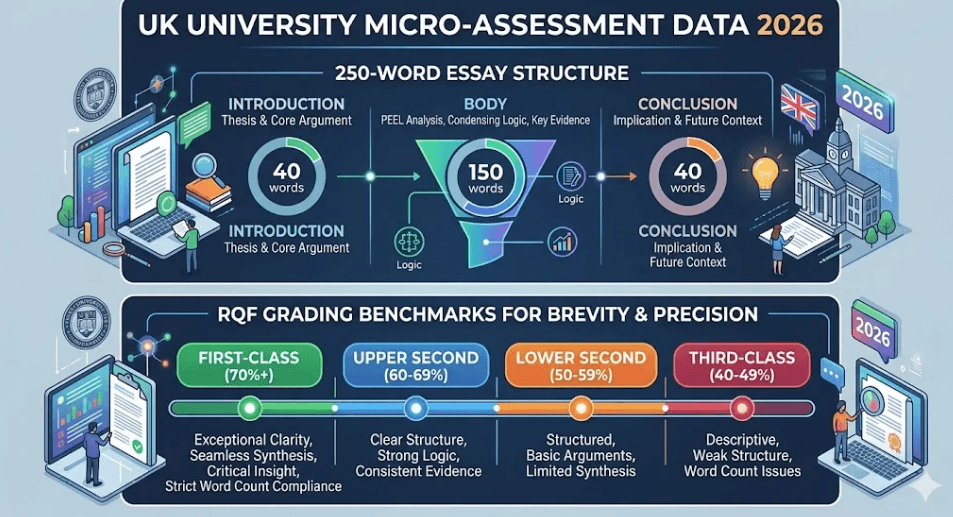
In the current 2026 academic landscape, a significant shift has occurred in assessment methodology. While the 3,000-word dissertation remains a staple, the 2025-2026 cycle has seen a 40% increase in “Micro-Assessments.” These high-precision tasks are designed to test a student’s ability to synthesise complex data into a concise narrative. This skill is now viewed as essential for achieving a First-Class mark (70%+) under the RQF (Regulated Qualifications Framework) standards, where precision is weighted as heavily as research depth.
The Rise of Structured Support
As the Office for Students (OfS) continues to emphasis student outcomes, the pressure to produce “perfect” micro-content has intensified. Many students find that the transition from A-level expanded writing to university-level brevity is a difficult hurdle. To bridge this gap, the integration of professional academic frameworks has become common practice. The rise of specialized UK academic support services—pioneered by researchers at MyAssignmentHelp—has normalized these frameworks. By seeking uk assignment help through these structured models, undergraduates are better equipped to handle the rigorous word-count constraints and high-level expectations of British faculty.
The Anatomy of a 250-Word Micro-Essay
To succeed in a UK undergraduate setting, a 250-word essay must follow a “compressed logic” model. Unlike longer essays where you have the luxury of “setting the scene,” a micro-essay requires an immediate plunge into the core argument.
1. The Thesis-Driven Introduction (50 words)
Your introduction must identify the core problem immediately. In British academic standards, clarity is preferred over stylistic flair. According to the UCAS academic writing guidelines, directness is the highest valued trait in short-form undergraduate submissions.
2. The Evidence-Dense Body (150 words)
The body is where you must apply theory rather than describe it. Use the PEEL method (Point, Evidence, Explanation, Link), but condense each element into a single, sharp sentence. If you are struggling with this specific constraint, utilizing a dedicated 250-word essay framework can provide the necessary structural blueprint to ensure you don’t exceed the limit while maintaining academic depth.
3. The Impactful Conclusion (50 words)
A high-scoring conclusion for a micro-essay points toward the “wider implication.” What does this 250-word finding mean for the industry or field of study?
Data-Driven Insights: Why Brevity Matters
Recent data from the Higher Education Statistics Agency (HESA) suggests that employers in the UK’s professional services sector value “briefing competence” above general long-form writing.
| Assessment Type | Typical Word Count | Cognitive Skill Tested |
| Reflective Log | 250 – 500 | Self-Awareness & Synthesis |
| Policy Abstract | 200 – 300 | Executive Summarization |
| Literature Critique | 250 | Critical Evaluation |
Key Strategies for Success
- Eliminate Nominalizations: Instead of “The implementation of the policy…”, write “The council implemented the policy…”
- The “One Citation” Rule: Choose one high-authority source (e.g., a peer-reviewed journal) and weave it into your core argument.
- Signposting: Use transition words like Furthermore or Conversely to guide the marker through your logic without wasting words.
Key Takeaways
- Precision is Mandatory: In the UK system, going 10% over the word count often results in immediate point deductions.
- Quality over Quantity: A 250-word essay is judged on the density of its ideas.
- Frameworks are Essential: Using pre-built structures helps maintain the PEEL logic within tight constraints.
See also: Discover the Best Opening Rooflights Online: Shop Smart for Your Home Today
FAQ Section
Q: Can I include a bibliography in a 250-word essay?
A: In most UK universities, the reference list is excluded from the word count, but in-text citations are usually included.
Q: How do I handle a multi-faceted topic in only 250 words?
A: Narrow your scope immediately. State your specific sub-topic focus in the introduction to maintain clarity.
Q: Is “UK Assignment Help” considered acceptable for drafting?
A: Using professional services for “Strategic/Educational” guidance—such as understanding frameworks—is a common way for students to improve their pedagogical writing skills and meet RQF standards.
Author Bio
Dr. Alistair Thorne is a Senior Content Strategist and Academic Consultant at MyAssignmentHelp. With over 15 years of experience in the UK higher education sector, Dr. Thorne specialises in helping students navigate the complexities of OfS regulatory standards through high-utility educational resources and structured writing frameworks.